

Finding a “good driving job” sounds simple—until you start comparing listings. One post promises great pay but hides the schedule. Another says “local routes” but turns into long days with heavy loading. And if you don’t have a CDL, many roles feel out of reach.
Read This Also: Driver Job Car Provided USA – $17.87/Hour Night & Weekend Work
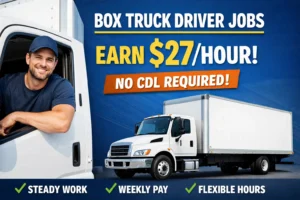
This guide is for anyone in US, or the UK researching box/straight truck driver jobs, especially roles that pay well, offer flexible hours, and provide benefits. I’m using a common real-world setup as the example: $27/hour, full-time/part-time/temporary options, benefits like health insurance and 401(k), and no CDL required (Class C). Even if your country’s licensing rules differ, the day-to-day workflow and hiring checks are very similar.
What a Straight/Box Truck Driver actually does day-to-day
In most companies, your job is not “just driving.” It’s a mix of road work, safe handling, and customer-facing professionalism.
Here’s what a normal day usually looks like:
-
Vehicle check before you move
I’ve seen drivers lose half a day because a small issue (tire pressure, lights, leaking fluid) wasn’t caught early. A quick walk-around saves time and prevents roadside trouble. -
Route review + pickup plan
Even if dispatch assigns routes, you should glance at stops and traffic patterns. The best drivers don’t “race”—they plan. -
Load, secure, and balance cargo
Most delivery damage happens because items weren’t secured. A sudden brake can turn boxes into a mess. Straps and smart stacking matter. -
Deliver, confirm, communicate
You’ll deal with customers, security guards, receiving staff, and sometimes confused addresses. Calm communication keeps you moving. -
Post-trip check + basic notes
This is where you avoid the next day’s headache—report any issues, return paperwork, and close out the route.
Pay, schedule, and what “flexible” usually means
This example role offers $27 per hour, and it can be full-time, part-time, or temporary. In practical terms, “flexible schedule” can mean:
-
You choose from available shifts (morning/afternoon/evening)
-
You take extra hours during peak demand
-
You can prefer part-time if you have other work or study
Why this matters: Driving jobs can look great on paper but become exhausting when schedules are rigid. Flexibility helps you keep the job long-term without burnout.
Read This Also: Best Wall Art Ideas for Small Spaces – Simple Decor Tricks
Benefits that actually make a difference
When a box truck role includes benefits, it’s not a small thing. In this listing, benefits include:
-
401(k) + 401(k) matching
-
Health insurance
-
Dental insurance
-
Vision insurance
-
Paid time off
-
Flexible schedule
If you’re in the US, 401(k) and matching can add real long-term value. In the UK/India, you may see different equivalents (pension, PF/ESI), but the logic is the same: benefits reduce stress and protect you from “one bad month” wiping out savings.
Requirements: what’s needed (and what’s not)
This job is open to drivers with a valid Class C license suitable for straight/box trucks. A CDL is NOT required.
What employers usually want:
-
Comfort driving larger vehicles than a car
-
Clean and safe driving habits
-
Basic delivery experience (helpful, not always required)
-
Ability to lift/move items safely
-
Decent communication and customer service
Tip from experience: Many candidates get rejected not because they can’t drive—but because they show up late, argue about basic rules, or treat customers rudely. In delivery work, attitude is a real skill.
A practical “first week” routine that helps you succeed
If you get hired, here’s a simple routine that keeps you ahead:
-
Day 1–2: Learn the vehicle dimensions (turning radius, reverse, mirrors)
-
Day 3: Practice loading patterns (heavy bottom, fragile top, strap tight)
-
Day 4–5: Focus on pace—smooth driving, clean stops, simple customer talk
-
End of week: Review mistakes (late stop? wrong gate? missing signature?) and fix one thing at a time
Why this works: Most drivers fail early because they try to “go fast.” The goal is to go smooth, not fast. Smooth reduces damage, delays, and complaints.
Common mistakes (and how to fix them)
Mistake 1: Skipping inspections
Fix: 2-minute walk-around. Lights, tires, mirrors, fuel, and leaks.
Mistake 2: Poor cargo securing
Fix: Use straps, avoid over-stacking, keep heavy items low.
Mistake 3: Getting lost at delivery points
Fix: Call ahead when needed. Confirm entrance/gate details early.
Mistake 4: Being “too quiet” with customers
Fix: Simple script: “Hi, delivery for __. Can you confirm name/signature?”
Quick checklist before you apply (copy/paste)
-
I have the correct license for a box/straight truck (Class C or local equivalent)
-
I’m comfortable driving a larger vehicle in traffic
-
I can lift and move packages safely
-
I can follow routes and handle multiple stops
-
I’m okay with customer interaction
-
I can pass basic background/safety checks if required
Takeaway
A good box truck job isn’t only about the hourly rate. The best roles combine steady pay, reasonable scheduling, real benefits, and a safety-first culture. If you like independent work, are careful with vehicles and cargo, and can communicate politely, this kind of job can be a stable and respectable path.
FAQs (real questions people ask)
1) Do I need a CDL for box truck driver jobs?
Not always. Many roles use straight/box trucks that can be driven with a Class C license (or local equivalent). Always check vehicle weight limits and local rules.
2) What’s the hardest part of this job for new drivers?
Usually loading/unloading and time management—not driving. Learning how to secure cargo and keep stops efficient is what makes the job smoother.
3) Are box truck driver jobs physically demanding?
They can be. Even if items are not extremely heavy, repeated lifting and moving adds up. Good shoes, safe lifting technique, and pacing help a lot.
4) What does “temporary” mean in driving jobs?
It often means seasonal demand, a short contract, or coverage for peak weeks. It can still lead to longer work if performance is good.
5) What should I bring on the first day?
Driver’s license, comfortable workwear, a phone charger, water, gloves (optional), and any required documents. Also carry a small notebook for route notes.
6) Can people with a criminal record apply?
Some employers encourage applications and consider candidates fairly. Hiring depends on the role and the nature of the record, so it’s best to be honest upfront.
7) How do I avoid getting complaints from customers?
Be on time, communicate clearly, handle items carefully, and keep your tone calm—even if the customer is stressed. Professional behavior solves most problems.








Leave a Comment